How MQTT fits in modern IIoT architecture
No access to YouTube? Click here to view locally
For several reasons, it works best at the edge
MQTT fits best in the Industrial IoT at the edge. It is a simple, efficient messaging protocol designed to connect remote devices and applications to a central location, and it performs well at that task. The MQTT publish/subscribe model makes it a good choice for unreliable or bandwidth-limited networks such as are often found at the edge.
Multi-hop connections
We need to keep in mind that MQTT was not really designed for the Industrial IoT. Many plant-level and most enterprise-level Industrial IoT applications require support for multiple-hop networking to pass data from device to plant to DMZ to IT or the cloud. These kinds of backbone IIoT connections were unheard of when MQTT was on the drawing board. The MQTT Quality of Service guarantees are fragile across multiple connections, and it does not handle data overloads well.
IIoT needs consistent data
Instead of quality of service, what is needed for Industrial IoT is guaranteed consistency of data from the source to the user, at every step. Let’s take a basic, three-step connection from OT through a DMZ to IT as an example.
Suppose we have a device sending MQTT messages to an MQTT broker in the DMZ that then need to be passed along to second MQTT broker in IT. MQTT does not allow for broker-to-broker connections, so on the DMZ, the data would have to be received by an MQTT client, then resent as a separate MQTT message to the broker on the IT side.
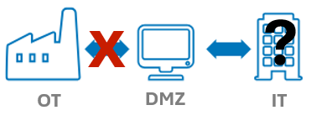
If there is a break in the connection from OT to the DMZ, the MQTT client in IT would not necessarily be informed. MQTT does not provide a way to convey the quality of the data itself, just the quality of service, and the service between the DMZ and IT may be working just fine. MQTT cannot guarantee consistency of data across multiple connections, just quality of service over a simple, one-hop, device-to-broker link.
This is why MQTT is best used as an edge protocol. One-hop MQTT connections can feed the data securely and reliably to a connecting application like the DataHub Smart MQTT Broker, which can then aggregate it with other OT data, and send it via DHTP through a DMZ to IT or the cloud.


