7.5.5. Bridging and Tunnelling
Bridging with tunnelling means linking servers to servers or clients to clients across a network. Here's how it's done, using OPC as an example:
Bridging two OPC servers over a network.
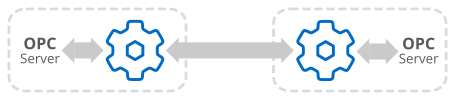
This scenario involves setting up DataHub instances on both machines to act as OPC clients to the respective OPC servers. The DataHub instances then interface with each other over a TCP tunnelling connection. Configure the DataHub instance on the machine with the most uptime to be the tunnelling master and the other DataHub instance to be the tunnelling slave. Or, if one server needs more firewall protection, you can configure that one as the tunnelling slave, so that DataHub instance can make an outbound connection.
![[Note]](images/note_1156523861.png) | |
The bridging configuration and license only needs to be on one of the two DataHub instances. If you are configuring multiple tunnels in a hub-and-spoke scenario, the best place for the bridging license and configuration would be on the DataHub instance acting as the hub. That way, any connected server can connect to any other. |
Bridging two OPC clients over a network.

This scenario involves setting up DataHub instances on both machines to act as OPC servers to the respective OPC clients (see above). The DataHub instances then need to interface with each other over a TCP tunnelling connection. Configure the DataHub instance on the machine with the most uptime to be the tunnelling master and the other DataHub instance to be the tunnelling slave. Or, if one client needs more firewall protection, you can configure that one as the tunnelling slave, so that DataHub instance can make an outbound connection.