Chapter 5. Tunnelling OPC DA
5.1. Introduction
When talking about data networks, tunnelling means to encapsulate one protocol inside another, to allow it to be sent more easily and/or securely across the network. The Cogent DataHub program tunnels OPC DA to avoid the problems of DCOM configuration commonly encountered when using OPC DA.
![[Note]](images/note_1156523861.png) | |
With DataHub software you can also tunnel other protocols, such as OPC A&E or OPC UA. For each of them, server and client connections are protocol-specific, while the tunnelling configuration is the same as discussed here. |

Using the Cogent DataHub program for tunnelling OPC DA means:
Connect equally easily across a LAN or WAN.
No DCOM—no timeouts or configuration problems.
Complete and secure data access.
Simple set up.
Configuring a DataHub instance for tunnelling OPC DA is a simple, 3-step configuration that can be done in a few minutes. All you need to do is:
Why use tunnelling for OPC DA?
Most people who attempt to network OPC DA servers and clients experience a number of problems. Networking is just not OPC DA's strength. OPC DA was originally based on COM (component object model), which runs on a single computer.

As long as the OPC DA server and client are on one computer, setting up the connection between them is easy. Difficulties arise, however, when an OPC DA server and client are on different computers, and need to be networked.

To communicate over a network, OPC DA uses DCOM (distributed COM), which many system engineers find to be inadequate for their needs. DCOM can time out for up to 5 minutes at a time, and there are problems related to running computers in different security domains. As the number of networked OPC servers and clients increases, the difficulties with DCOM increase exponentially. It is very difficult over a LAN, and most people don't even attempt it over a WAN.
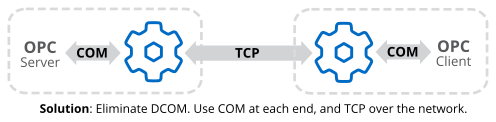
The DataHub program provides a COM (OPC DA) interface for the OPC DA client and server, and uses DHTP over TCP across the network. This is known as tunnelling. Each connected OPC DA server or client sees the other as a local OPC connection. They are unaware that their messages are being converted to TCP along the way. Tunnelling works equally well across a LAN or WAN, and it is even possible to tunnel through firewalls. See Typical Scenarios for more information.