9.4. Multiple Redundant Pairs
The Redundancy feature can accommodate any number of redundant pairs. Typically this means separate pairs, like A1/A2, B1/B2, C1/C2, and so on where A, B, and C are the data sources for the redundant pairs. To do this, each redundancy pair must have a unique output domain. You cannot send data from multiple redundancy pairs into a single output domain.
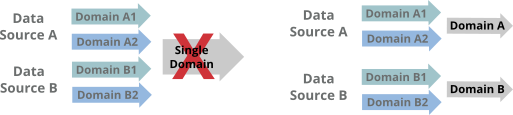
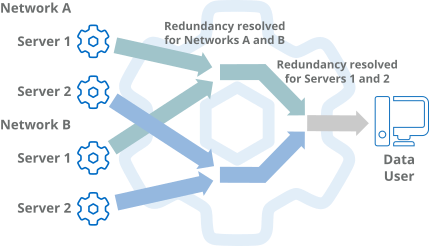
It is also possible to configure redundancy for multiple identical redundant sets coming from a single source of data. For example, you may want to configure redundancy for 4 data paths from a single source, where you have 2 redundant servers running on 2 redundant networks. Redundancy in this scenario would need to be resolved in two stages.
In the first stage you could resolve the redundant networks into a pair of outputs, one for each server. At the second stage you would resolve the redundant servers to a single output.
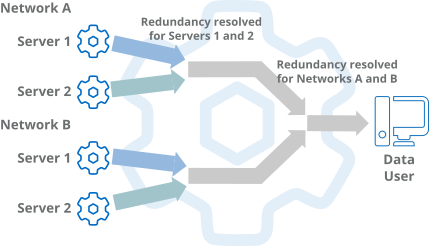
Alternatively, you could resolve the redundant servers to one output for each network, and then resolve the redundant networks into a single output.
Memory Limitations
There are no programmed-in limits on the number of domains or redundancy pairs. The practical limit is typically the number of data points that the DataHub instance can handle before running out of memory. The total data point count is the sum of the data points counts in each domain.
The number of domains is the total of all input and output domains on the DataHub instance resolving the redundant connections. On the simplest redundant system that would be 2 inputs and 1 output, for a total of 3. This means you need to ensure you have enough memory for 3 times the number of points as are in one of the source domains.
In the more elaborate scenarios shown above, at the first level you have 4 inputs and 2 outputs, or 6. At the second level the two input domains have already been counted (as outputs on the previous level). You just need to add the final output domain for a total of 7. So on the DataHub instance that is resolving the redundancy, you need 7 times the amount of memory that a single domain would require.